
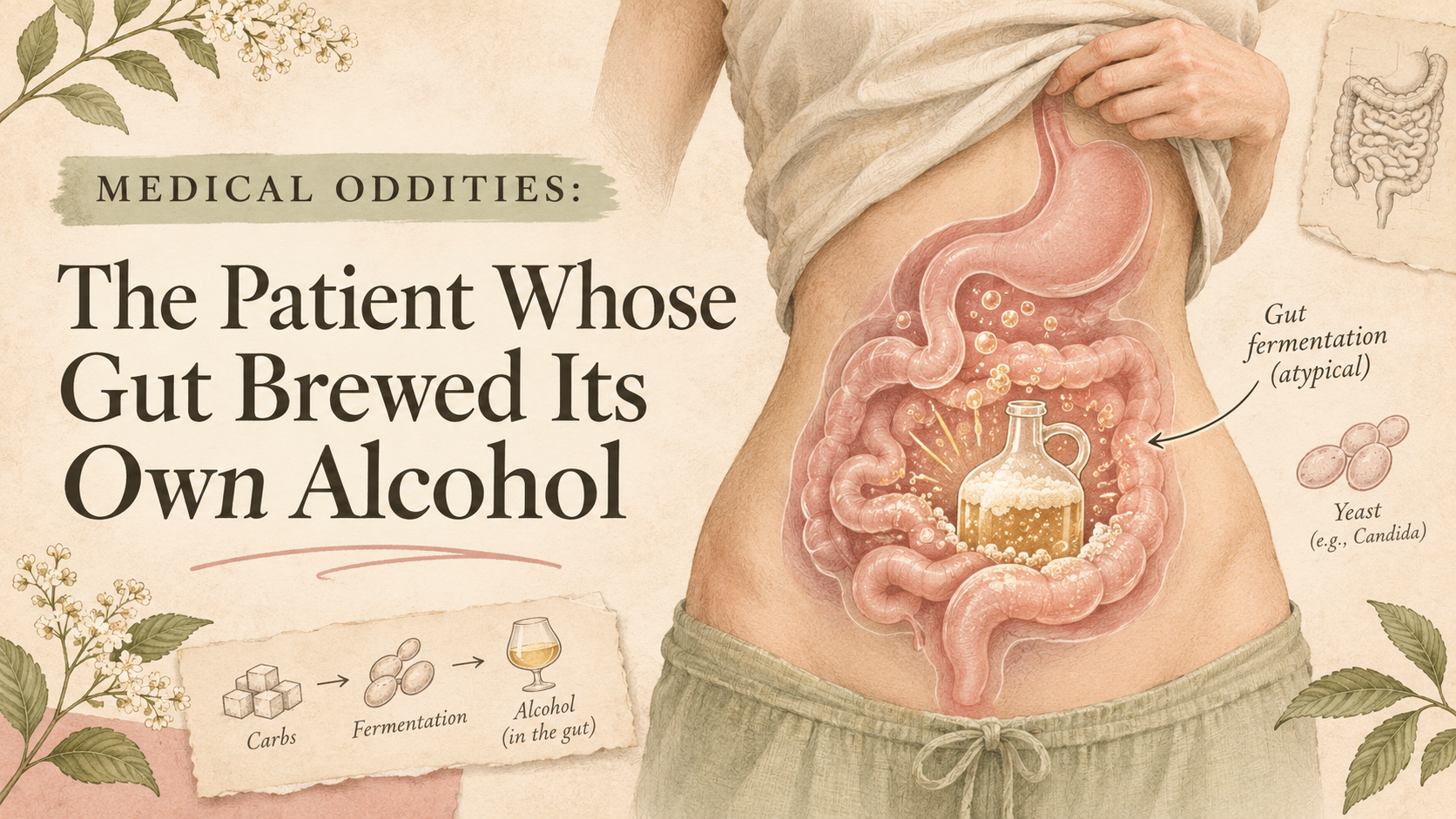
Imagine you’re waking up one morning and you’re noticing that your head is feeling all fuzzy, you’re struggling to really focus and concentrate on one thing… and on top of all that you notice the feeling of a hangover, like on those days you experimented with a new drink and didn’t realize it would hit you that hard.
Yet you experience that record scratch moment when you remember that one rather important detail:You haven’t had a single drop of alcohol. Not today, not yesterday, heck probably not even in a long while.
Now imagine this happening repeatedly. You’re wondering why you’re experiencing hangover-like symptoms every few weeks but with no plausible explanation. And to make it worse, people around you might start questioning your drinking habits, and understandably, you’d probably start questioning what on earth was happening inside your body.
Well, believe it or not, there are documented cases of people becoming intoxicated without drinking alcohol. And the culprit?Apparently, their gut decided to open its own little brewery.
A Patient That Was Drunk Without Ever Drinking
In 2019, researchers published the case of a 46-year-old man who had been experiencing some rather unusual symptoms for years. So far, it couldn’t be connected to anything. His problems originally began after he received a three-week course of antibiotics for a thumb injury. Shortly afterward, he started experiencing episodes that consisted primarily of brain fog, memory problems, unusual behaviour and mood changes.
Initially, nobody had an obvious explanation. Then things became considerably more serious. One morning, he was arrested on suspicion of drunk driving. In order to get his blood alcohol content tested, he needed to go to the hospital. At the hospital, his blood alcohol concentration was measured at 200 mg/dL, equivalent to 0.20%. That is more than just a small amount of alcohol in someone’s bloodstream, and definitely over the legal limit to drive! (For reference, Canada and the US’s limit is 0.08%, in some EU countries like the Czech Republic 0.00% or Germany with 0.05%).
Here is where the situation takes a not unusual turn, however, questions just kept arising. This is because, when questioned, the patient repeatedly insisted that he hadn’t been drinking even a single drop of alcohol. Most people claim they haven’t consumed any alcohol, even if they did, but for this patient it was actually the truth! Eventually, after further investigations, doctors discovered something quite out of the ordinary. The man had a condition called auto-brewery syndrome, also known as gut fermentation syndrome.
Ok, Soo… How does ones gut end up brewing alcohol?
You know how yeast is used to ferment sugars when brewing beer or wine? Turns out that there is a possibility where a similar process can actually happen inside of our human digestive system.
To break it down a little further: Within our intestines there are enormous communities made up of microorganisms. Within these communities there are also different bacteria and in smaller numbers there are fungi.
Within these, there are some of these organisms that have the ability to break down the carbohydrates that we get from the food that we eat. This process is called fermentation, a byproduct of this process is the production of ethanol. Ethanol with the ending -ol is a form of an alcohol. In the usual case, there aren’t ever enough of these around that produce such an excess of ethanol, that someone would get drunk off of it. However, with patients that suffer from auto-brewery syndrome, these specific microorganisms that produce the alcohol can become either extremely active, or there can just be a whole lot of them.
The process is such that someone will eat the carbs, for example in an unusually carb heavy meal. This is basically a feast for these organisms. When there are so many of them, they may be able to produce enough ethanol among themselves for measurable amounts of alcohol to end up entering the bloodstream. And there we have the key evidence: if such a case happens, then yes, someone can actually turn out to have such a high alcohol content in the blood, that by definition they are drunk.
So what happened? In this patient’s case, researchers suspected that his earlier antibiotic treatment had disturbed his normal gut microbiome, allowing alcohol-producing fungi to grow. That’s a plausible explanation, although the antibiotics couldn’t be proven to be the sole cause.
🔬 For the curious: But how did doctors actually end up proving this for our patient?
The doctors decided to do some interesting testing: The patient underwent a supervised carbohydrate challenge. Rather than simply taking his word for it, doctors monitored him while he consumed carbohydrates and measured what happened to his blood alcohol levels. After eight hours, his blood alcohol concentration had risen to 57 mg/dL. And he hadn’t consumed an alcoholic drink during the monitored test. Further investigations identified fungi in his gastrointestinal tract, including species capable of producing alcohol.
This also came with a bit of a catch: Treatment wasn’t straightforward. He experienced relapses and required several antifungal treatments before his symptoms resolved. Eventually, after a course of intravenous antifungal medication, his follow-up testing no longer detected the earlier fungal growth, and he could gradually return to eating a normal diet.
At approximately 18 months of follow-up, the case report described him as symptom-free.
Once again, there IS an important catch!
While this may sound like a decent excuse if you ever happen to be randomly questioned: Auto-brewery syndrome is rare, and the exact number of people affected isn’t well established. A single case report also doesn’t tell us how often this happens or whether one treatment will work for everyone.
Diagnosis requires careful medical evaluation, ruling out other explanations and objectively demonstrating alcohol production under monitored conditions. Simply finding yeast or bacteria in someone’s stool isn’t enough.
And the most important part: regardless of why someone feels intoxicated, driving while impaired remains dangerous.
🕳️ 🐇 Wait! So just plain yeast isn’t our only culprit here?
For a long time, many documented cases focused on alcohol-producing yeasts. But a study published in January 2026 investigated 22 patients with auto-brewery syndrome and 21 unaffected household partners. The researchers found that stool samples collected during symptomatic episodes produced more ethanol under laboratory conditions.
They also identified changes involving certain bacteria, particularly Escherichia coli and Klebsiella pneumoniae. So apparently, our gut brewery doesn’t necessarily need traditional brewer’s yeast to start producing alcohol. The study offers stronger clues about the microorganisms involved, although it doesn’t establish one universal cause or cure.
The Bottom Line
Yes, your gut really can produce alcohol. In the rare condition called auto-brewery syndrome, fermentation from certain microbes can generate enough ethanol to cause genuine symptoms of intoxication, even without drinking.
And while the idea of a miniature brewery operating inside someone’s intestines sounds almost comical, the consequences for affected patients can be anything but funny.
Personally, I think this might be one of the strangest examples yet of how our own microbiome can surprise us.
References & Sources
View the sources behind this story
- Malik F, Wickremesinghe P, Saverimuttu J.
Case report and literature review of auto-brewery syndrome: probably an underdiagnosed medical condition.
BMJ Open Gastroenterol. (2019)
[View the Source] - Hsu CL, Shukla S, Freund L et al.
Gut microbial ethanol metabolism contributes to auto-brewery syndrome in an observational cohort.
Nat Microbiol. (2026)
[View the Source] - Damianos J, Cordell Barbara J., Nathani Rohit R., Sticco Kristin L
Auto-Brewery Syndrome
[View the Source]
Written by A Dose of Proof
Health research can be fascinating — but the way it’s written often makes it much harder to understand than it needs to be.
A Dose of Proof is the voice behind After the Abstract, translating health research into clear, evidence-focused explanations that look beyond the headline — including what a study found, what it didn’t prove, and whether the results actually matter.
Leave a Reply