
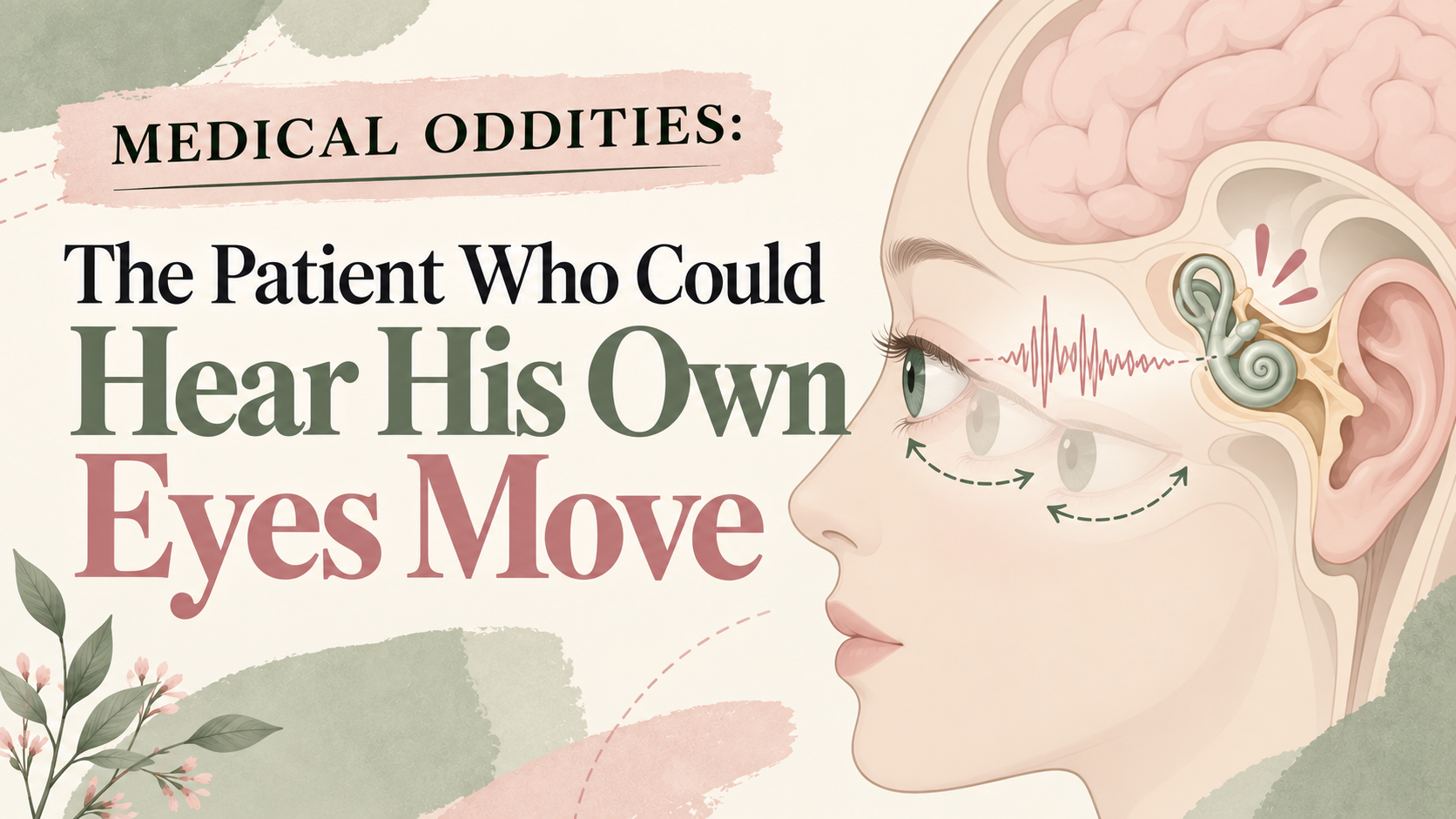
This medical oddity comes from being able to hear something that would send most of us down the anxiety spiral. Imagine you’re just sitting in a quiet room, there’s no tv running or music faintly playing. Maybe not even the steady hum of a fan or ac.
But there’s a constant noise that you cannot escape, and that noise is being made by your own EYEBALLS moving about in your eye socket.
So every time your eye focuses on a small speck of dust floating in the air or a bird flying outside the window, every little movement, there’s an unusual yet unsettling sound that you can feel coming from somewhere inside your head.
I’m sorry, what?! Is this a story about a medical oddity or the opener to a new genre of horror movie. Pretty close, but no, actually this is describing a documented medical phenomenon.
As it turns out, the reality of how this came to be has less to do with your eyes and much more with a tiny little hole within your inner ear.
A patient with a rather unusual symptom…
In 2017, researchers published a scientific review describing a rather unusual finding within a patient. A 40-year-old man had been experiencing strange symptoms involving his left ear for six years. He reported feeling as though his ear was constantly full, hearing his own heartbeat, and experiencing changes in how his own voice sounded. This combination of symptoms would be quite annoying for most people to experience all at once. However, there was more to it. One peculiar symptom stood out in particular: He described that he could actually hear his own eyeballs moving in his left ear.
Now imagine trying to have to explain that at your doctor’s appointment. One can only hope that the physician will take them seriously. Thankfully, his unusual symptoms were investigated further. And what the doctors eventually discovered was something nobody would have guessed just by looking inside his ear.
After investigating his symptoms, they identified a condition with an exceptionally long name: superior semicircular canal dehiscence syndrome, or SCDS for short.
And despite sounding like something you’d need at least three attempts to pronounce correctly, there’s a surprisingly understandable explanation behind it all.
So… what was actually going on?
Deep inside your inner ear are three tiny, fluid-filled structures that are called semicircular canals. They’re part of your balance system, essentially they take part in helping your brain detect how your head is moving. Normally, these structures are surrounded by bone. But in people with superior semicircular canal dehiscence like the original patient, a part of the bony covering over the uppermost canal is either missing completely or unusually thin. What this does, is it creates an additional opening that researchers call a third mobile window.
Under normal circumstances, your inner ear has two. These are involved in transmitting sound. When an unexpected third one appears, suddenly the way sound and pressure travel through the inner ear changes completely. What can happen due to that, is that sounds from inside your own body can become unusually noticeable. So sounds like your heartbeat, your voice, or even the movement of your eyeballs are suddenly a lot louder.
The condition can also affect balance, causing dizziness or the sensation that your surroundings are moving when exposed to certain sounds or pressure changes that ‘normal people’ will never experience. All of this trouble can happen because of one tiny structural abnormality. Talk about humans being fragile, huh.
🔬 For the curious: How did the doctors even figure this one out?
So the interesting part is that Doctors didn’t simply look inside his ear and exclaim “hey, here’s a visible hole.” Instead, they performed specialized hearing and balance tests, including tests measuring how the balance system of our bodies responds to sound. The results suggested that sound and pressure were being transmitted abnormally through his left inner ear. A high-resolution CT scan then revealed the opening above his superior semicircular canal, so that was the “oh, here it is moment”.
During surgery, doctors found that the opening measured approximately 5 by 1 millimetres. So they went and plugged the affected canal, and afterward, the patient’s abnormal perception of internal sounds had already improved. His hearing was also preserved. Kind of crazy how such a small opening, barely a few millimeters across, can impact someone’s life so drastically.
There is an important catch, though!
Not everyone who has this anatomical opening will actually go on to experience symptoms. And probably more importantly, seeing an opening on a CT scan alone doesn’t automatically mean someone has SCDS.
In order to form a proper diagnosis, it requires a combination of characteristic symptoms, specialized testing and appropriate imaging. Doctors also need to consider other conditions that might explain the symptoms before going straight to the rare diagnosis. So for anyone that is prone to getting a little bit of health anxiety: if you’ve experienced an unusual sound in your ear recently, it certainly doesn’t mean you’ve got this particular condition.
The case is fascinating precisely because the patient’s symptoms, test results and imaging findings fit together and came to this diagnosis.
🕳️ 🐇 One second.. sound can make your eyes actually move?
Okay, apparently this rabbit hole gets even stranger than this case already is.The condition was first described by Lloyd Minor and colleagues in the year 1998. One of the unusual findings was that loud sounds or changes in ear pressure could trigger involuntary eye movements. This happens because the extra opening can cause sound and pressure to stimulate the balance system in ways they ordinarily wouldn’t.
So to explain this in easier language: If this person can hear their actual eyeballs moving because of an abnormality within their inner ear, then that same abnormality can sometimes be the cause of their eyes moving in response to a sound stimulus. Isn’t that fascinating!? The human body is constantly showing us new surprises nobody could’ve even dreamt of.
The Bottom Line
Yes, this actually happens, some people really can hear their own eyeballs moving. It is definitely an unusual but documented symptom of a condition that is caused by a small hole in the bone surrounding your inner ear.
And while even to me this sounded completely unbelievable out of this world at first, the underlying explanation comes down a multitude of factors such as anatomy, sound transmission and the close relationship between your hearing and balance.
Personally, I think I’ll appreciate the relative silence of my own eyeballs a little more tonight.
References & Sources
View the sources behind this story
- Ward BK, Carey JP, Minor LB. (2017).
Superior Canal Dehiscence Syndrome: Lessons from the First 20 Years.
Frontiers in Neurology.
[Read the Source] - Ward BK, et al. (2021).
Superior semicircular canal dehiscence syndrome: Diagnostic criteria consensus document of the Bárány Society.
Journal of Vestibular Research.
[Read the Source] - Johns Hopkins Medicine.
Superior Canal Dehiscence Syndrome (SCDS).
[Read the Source]
Written by A Dose of Proof
Health research can be fascinating — but the way it’s written often makes it much harder to understand than it needs to be.
A Dose of Proof is the voice behind After the Abstract, translating health research into clear, evidence-focused explanations that look beyond the headline — including what a study found, what it didn’t prove, and whether the results actually matter.

Leave a Reply