
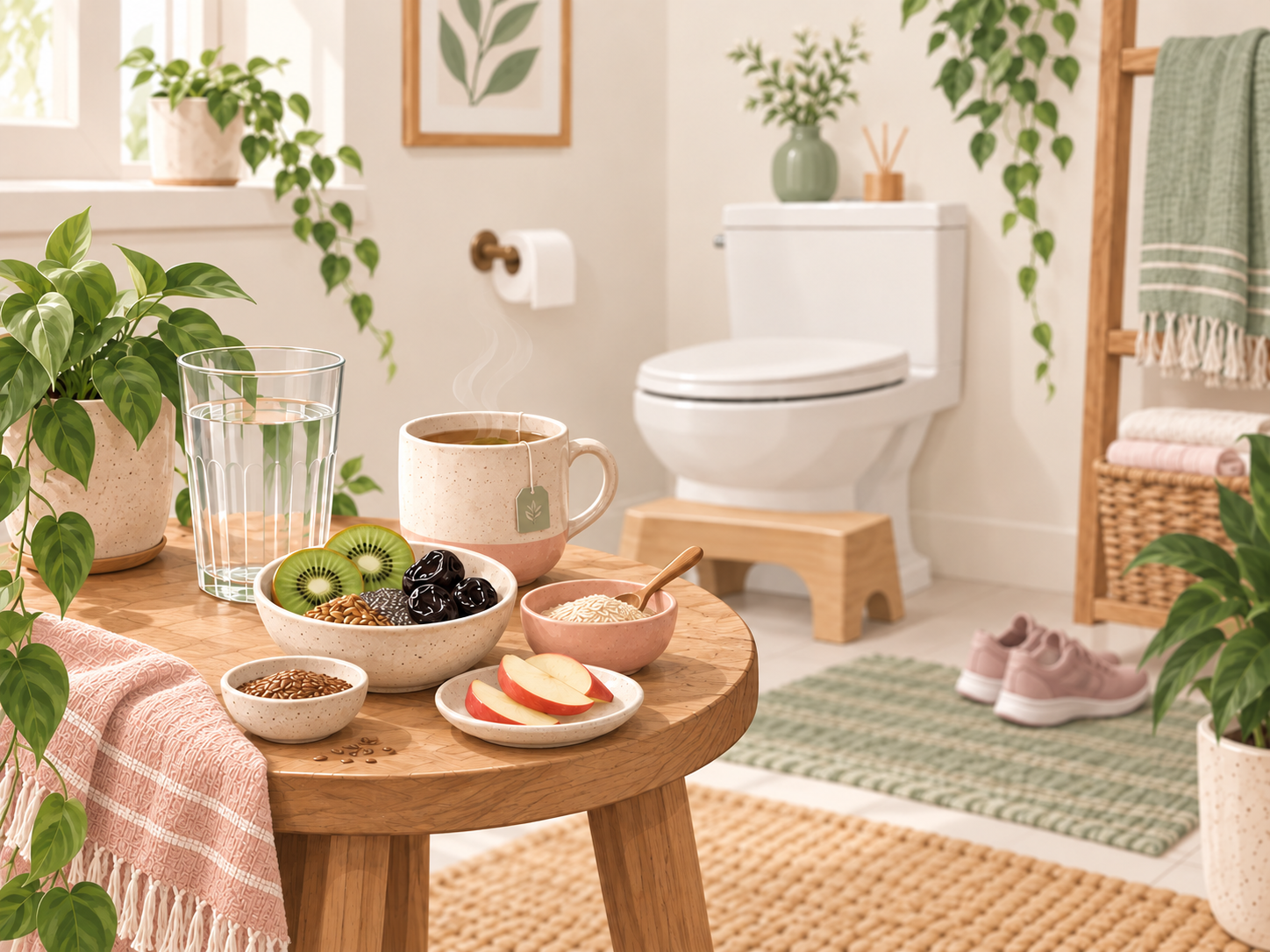
We’ve all been there: sitting on the toilet, straining, bargaining with heaven and hell just to let THIS ONE go.
Maybe it was yesterdays takeout. Maybe your routine has been completely off. Maybe your digestive system has simply decided that today, apparently, is not the day.
Either way, one thing becomes very clear: You just can’t poop.
And the internet has approximately twelve thousand solutions for that. Eat more fibre. Drink something probiotic. Have a kiwi. Take magnesium. Massage your stomach. Put your feet on a tiny stool and assume the poop-position.
But which of these actually have evidence behind them?
Let’s look at some of the most common recommendations people reach for before jumping straight to stronger medications and see what might genuinely help get things moving.
The Short Answer
Some of them actually do work! BUT “just eat more fibre” is a little too simple.
The best evidence we found supports specific (!) types of fibre, especially psyllium, while certain foods, magnesium oxide and possibly abdominal massage can also help.
Probiotics are much less straightforward: some appear promising, but the effect seems to depend heavily on the specific strain. So there are things worth trying. Unfortunately, there is no universal “hey, let’s poop!” button.
So in plain English: So if you’re constipated, there are several remedies that are evidence-based that may help, however, not all equally effective.
The important distinction remains, that anything labelled “high fibre” or “probiotic” doesn’t automatically translate to: eat = poop.
What Does The Evidence Actually Say?
One thing shows up pretty consistently: fibre can help constipation (yay!) but the type of fibre matters.
A 2022 review of 16 randomised trials involving more than 1,200 adults found that fibre supplements increased bowel movement frequency, softened stools and made people more likely to respond to treatment overall.
Psyllium stood out particularly well. Higher doses and taking it for several weeks seemed to work better, although there was one predictable downside: more gas.
The newer British Dietetic Association guideline came to a similar conclusion and gave psyllium a strong recommendation. Interestingly, there wasn’t enough evidence to recommend an entire high-fibre diet as a treatment. This was because most studies actually tested specific fibres or foods instead of it as a whole diet.
Some other foods, also containing fibre, showed benefits too. Kiwifruit and rye bread may modestly increase bowel movement frequency, although neither appears to be a miraculous constipation cure.
And then there’s magnesium oxide, which is supported by both the BDA and AGA/ACG guidelines. Small trials found improvements in bowel movement frequency, stool consistency and other constipation symptoms.
So the evidence doesn’t really agree when we say: “Just eat more fibre.”
It’s closer to: “If you eat certain types of fibre, cool, but its not a one-for-all. Other specific interventions also help, but they are not interchangeable”
🔬 For the curious: But what about probiotics though?
This is where the answer becomes extremely annoying: All you can say is, that it depends.
Across the probiotic research, there is some evidence that probiotics as a group may increase stool frequency and improve constipation symptoms.
But when researchers start separating them by species and strain, the picture becomes inconsistent.
Some appear helpful. Others do basically nothing.
For example, Lactobacillus casei Shirota (you know, that famous strain that is found in products such as Yakult! (ps. not sponsored)) did not improve stool frequency or overall constipation symptoms in the evidence assessed by the BDA.
Another one, Bifidobacterium lactis did actually show some benefit in stool frequency. So overall.. probiotics are kind of a mixed bag.
So “take a probiotic” isn’t really an evidence-based answer by itself. Which probiotic? matters.
What Changes The Answer?
Constipation also isn’t one single problem with one single cause, its multifactorial, and can be caused by an incredible amount of aspects working together.
The referenced studies included different populations, different definitions of constipation, different doses and different treatment durations. Even the stronger reviews repeatedly point out considerable differences between the studies.
And something else that’s incredibly important to add: something working on average doesn’t mean it will work for every person.
Fibre is probably the clearest example: it can help, particularly when the right type and dose are used, but it can also come with bloating and enough tooting to make you reconsider your life choices once again.
What Does This Mean In Real Life?
If constipation rears its ugly head, there are reasonable things you can try before assuming your bowel has permanently retired for good.
Psyllium has some of the strongest evidence among fibre supplements. Certain foods such as kiwifruit may help. Magnesium oxide has promising evidence. And if one probiotic doesn’t do anything, that doesn’t necessarily mean every probiotic will, or that the word “probiotic” itself guarantees anything.
There’s even evidence for a completely different approach: abdominal massage.
A 2025 systematic review of 15 randomised trials found that manual therapies improved constipation severity, bowel movement frequency and quality of life. While these studies were all a bit different from one another, positive impulses were found.
(Who knows, maybe this is the moment your hands become magic!)
🕳️ 🐇 Rabbit Hole: So does putting my feet on a little stool help me poop?
I would say most people have definitely heard of this one. “Oh, you can’t poop? Just buy one of those little stools and put your feet on it. It’ll come right out no problems”
Apparently this was heard all the way to science world where they decided to actually go ahead and test it.
A 2023 randomised trial for instance, wherein two different footstool heights were measured to see if the change in posture was effective in expelling a balloon.
The result was a bit.. sobering. For sure their poop-posture was changed, but what it didn’t change was how quickly or subjectively “easy” the participants felt that the process was.
So just based on this study, nope, you do not need to go out and buy that little stool to become a pro-pooper. Does this also mean it won’t help anybody? Also no.
The take-home-message here is that maybe there’s a little too much confidence in the poop-stool setup and while it may help some, it’s not for everyone.
So therefore.. poop myth, partially busted?
EVIDENCE VERDICT
Promising, yet annoyingly specific.
How convincing is the evidence?
●●●○
Does it change what we should do?
Probably not.
What’s positive, is that there really is a decent amount of research out there. The big message, however, is not that simply “go eat some fibre.” is enough.
Some interventions seem to work a lot better than others: In fibre, that’s psyllium. It’s backed by fairly consistent support. Some foods show modest benefits, magnesium oxide is looking really promising, and just massaging your abdomen real well can produce genuine results.
However, take it with a grain of salt. A lot of the evidence is still rated of low-moderate certainty by it’s researchers. The effect can therefore also depend on product, dose, duration, and YOU as the person using it.
The Bottom Line
If you’re backed up, science delivers you some options that are backed by more than online repeated chatter or a century old sworn-by family recipe.
The star of the show currently is Psyllium. A light abdominal massage may leave you gunning for the toilet and magnesium oxide is waving at you with a surprising evidence base.
But please don’t treat constipation treatments as interchangeable. Fibre or Priobiotic on the package doesn’t translate to insta-poop. Your bowel, however unfortunate, remains as a little individual that is way more complicated than a one-for-all solution.
References & Sources
View the studies behind this article
- Dimidi E. et al.
British Dietetic Association Guidelines for the Dietary Management of Chronic Constipation in Adults.
J Hum Nutr Diet. (2025)
[Read the Study] - van der Schoot A, Drysdale C, Whelan K, Dimidi E.
The Effect of Fiber Supplementation on Chronic Constipation in Adults: An Updated Systematic Review and Meta-Analysis of Randomized Controlled Trials. Am J Clin Nutr. (2022)
[Read the Study] - van der Schoot A, Katsirma Z, Whelan K, Dimidi E.
Systematic review and meta-analysis: Foods, drinks and diets and their effect on chronic constipation in adults
Alimentary Pharmacology and Therapeutics
[Read the Study] - Doğan I et al.
Abdominal Massage in Functional Chronic Constipation: A Randomized Placebo-Controlled Trial
Physical Therapy (2022)
[Read the Study] - Chang L et al.
American Gastroenterological Association-American College of Gastroenterology Clinical Practice Guideline: Pharmacological Management of Chronic Idiopathic Constipation
Gastroenterology (2023)
[Read the Source] - Trieu RQ,et al.
Using a footstool does not aid simulated defecation in undifferentiated constipation: A randomized trial
Neurogastroenterol (2023)
[Read the Study]
Written by A Dose of Proof
Health research can be fascinating — but the way it’s written often makes it much harder to understand than it needs to be.
A Dose of Proof is the voice behind After the Abstract, translating health research into clear, evidence-focused explanations that look beyond the headline — including what a study found, what it didn’t prove, and whether the results actually matter.

Leave a Reply