
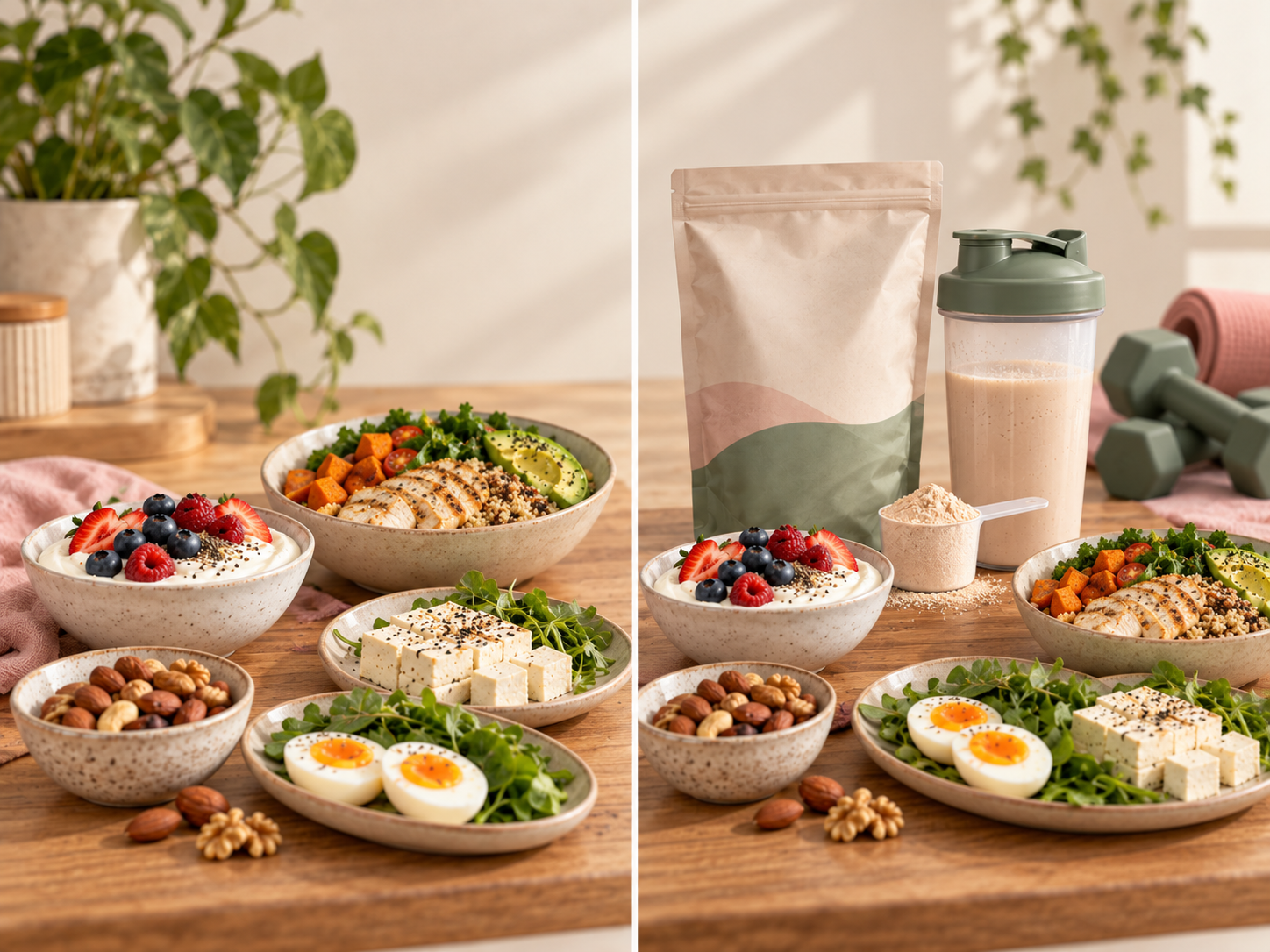
Protein has taken over fitness culture a little.
Protein shakes. Protein bars. Protein cereal. Protein coffee. Somewhere along the way, building muscle started to look suspiciously like a full-time job involving a shaker bottle.
Some people swear by a protein shake every morning. Others insist you can get everything you need from “regular” food. Then there is a third group carefully calculating every gram and somehow making both approaches work.
They all agree on one thing: protein matters if you want to build muscle.
But does that protein actually need to come from powder?
Or can a normal diet do the job perfectly well?
The Short Answer
No. You do not need protein powder to build muscle.
You do need enough protein, and you need to actually give your muscles a reason to adapt through resistance training.
Protein supplements can help if they make it easier for you to reach your protein intake. But if you are already getting enough through food, there is no requirement that some of it must come from a tub of vanilla-cookie-caramel-whatever popular protein powder.
So in plain English: If you enjoy your shake, keep drinking it. If you would rather eat your protein, that works too. The important parts are your total protein intake and your training, not the form in which your protein arrived from.
What Does The Evidence Actually Say?
One of the largest reviews on this topic looked at 49 studies involving 1,863 healthy adults completing resistance training. Protein supplementation did improve gains in muscle strength and fat-free mass compared with resistance training alone. But the benefit was not endless. Once total daily protein intake reached around 1.6 grams per kilogram of body weight, additional protein no longer appeared to produce further gains in fat-free mass.
A 2022 dose-response meta-analysis found something very similar for strength. Across 69 studies used in the dose-response analysis, increasing total protein intake improved muscle-strength gains when resistance training was also being performed. Without resistance training, increasing protein did not significantly improve strength.
The benefit increased up to around 1.5 g/kg/day, then levelled off.
That distinction is probably one of the most important bits that should be taken from this article.
One of the core messages of the referenced studies is that: Protein helps support the adaptation to training. It does not replace the training itself.
The International Society of Sports Nutrition, or ISSN for short makes the protein-powder question a lot easier for normal people to understand. Their position stand states that physically active people can meet their daily protein needs through whole foods. Protein supplements are described as a practical and convenient way of getting enough high-quality protein, particularly when someone’s training volume or dietary needs make that harder to achieve through food alone.
The answer isn’t that protein powder is NEEDED, but that it can definitely be used as a useful tool to achieve your goals.
🔬 For the curious: Does it matter when I drink my shake?
Probably much less than fitness culture sometimes makes it sound.
A 2025 review specifically compared consuming protein before versus after exercise. Timing did not meaningfully change gains in lean body mass.
There was a possible advantage for leg strength when protein was taken before training, but that finding came from a very small evidence base and was not enough for the researchers to make a strong conclusion.
So you probably do not need to finish your final rep and immediately grab and chug your shaker bottle. Getting enough protein across the day appears to matter more than hitting one tiny, perfect window.
What Changes The Answer?
Not everybody responds to additional protein in exactly the same way. As an individual, ones body and aspects regarding that can totally change the outcome.
Your age, training experience, activity level, baseline diet and total protein intake all matter.
For example, a 2020 review involving 657 healthy adults over 60 found that adding protein supplements to resistance training did not significantly improve strength or physical performance compared with resistance training alone.
That doesn’t mean protein becomes unimportant with age. It means simply adding a supplement does not guarantee an extra benefit if the rest of the picture is already adequate.
There is also no single perfect number that applies to every person.
ISSN suggests roughly 1.4 to 2.0 g/kg/day as a sufficient range for most exercising people, while the dose-response research around muscle and strength tends to show diminishing returns somewhere around 1.5 to 1.6 g/kg/day.
Those numbers are useful guides, and should not be taken as a hard cut-off amount.
What Does This Mean In Real Life?
If you can comfortably reach your protein needs through foods you already enjoy, there is no evidence-based reason that you must add protein powder.
Meat, fish, dairy, eggs, soy, legumes and other protein-rich foods all count.
If reaching your target is difficult, though, protein powder becomes a very practical tool.
Maybe you don’t have much appetite after training. Maybe you are busy. Maybe adding another full meal sounds deeply unappealing. In those situations, getting 20 to 30 grams of protein from a shake can simply be easier.
And convenience has value.
The important distinction, and at the same time probably the main point here: is that protein powder isn’t creating a special muscle-building effect that food alone can’t provide. It is mostly helping you reach an intake that supports the work you are already doing in the gym.
🕳️ 🐇 Rabbit Hole: Does this mean that up to the guide, more protein always means more muscle?
As much as anyone would wish for that answer to be yes… unfortunately not really. Both Morton and Tagawa found something close to a ceiling.
As total protein intake increased alongside resistance training, muscle and strength gains improved up to a point. Once intake reached roughly 1.5 to 1.6 g/kg/day, piling on more protein stopped producing clear additional gains in these analyses.
So if someone is already comfortably meeting their protein needs, doubling their shake intake probably isn’t unlocking a secret second level of muscle growth.
More is not automatically better. Sometimes more is simply… more protein.
EVIDENCE VERDICT
A solid evidence base with a fairly practical answer!
How convincing is the evidence?
●●●●○
We have large systematic reviews, dose-response analyses and position statements all pointing in a similar direction.
Protein intake supports muscle and strength gains, particularly when combined with resistance training. But the evidence does not say that protein powder itself is required.
Does it change what we should do?
Only if you are currently struggling to get enough protein.
If your normal diet already covers your needs, you can keep doing exactly that. This also means if you’re just out there enjoying protein powder that tastes like cake, also fine.
If your diet doesn’t, adding a protein supplement is a perfectly reasonable and convenient way to close the gap.
The Bottom Line
Protein powder does not build muscle because it is powder. It works because it contains protein.
If you’re resistance training and getting enough protein from your diet, you do not need a supplement simply because fitness culture says you should have one.
If a shake helps you reach your target more easily, great. Use it.
The important part is not the tub sitting on your kitchen counter. It’s getting enough protein overall and actually giving your muscles something to adapt to.
References & Sources
View the studies behind this article
- Morton RW, Murphy KT, McKellar SR. et al.
A systematic review, meta-analysis and meta-regression of the effect of protein supplementation on resistance training-induced gains in muscle mass and strength in healthy adults.
Br J Sports Med. (2018)
[Read the Study] - Tagawa R, Watanabe D, Ito K. et al.
Synergistic Effect of Increased Total Protein Intake and Strength Training on Muscle Strength: A Dose-Response Meta-analysis of Randomized Controlled Trials.
Sports Med Open. (2022)
[Read the Study] - Jäger, R., Kerksick, C.M., Campbell, B.I. et al.
International Society of Sports Nutrition Position Stand: protein and exercise
J Int Soc Sports Nutr 14, 20 (2017)
[Read the Study] - Labata-Lezaun N, Llurda-Almuzara L, López-de-Celis C, et al.
Effectiveness of Protein Supplementation Combined with Resistance Training on Muscle Strength and Physical Performance in Elderly: A Systematic Review and Meta-Analysis.
Nutrients. (2020)
[Read the Study] - Casuso RA, Goossens L.
Does Protein Ingestion Timing Affect Exercise-Induced Adaptations? A Systematic Review with Meta-Analysis.
Nutrients. 2025
[Read the Study]
Written by A Dose of Proof
Health research can be fascinating — but the way it’s written often makes it much harder to understand than it needs to be.
A Dose of Proof is the voice behind After the Abstract, translating health research into clear, evidence-focused explanations that look beyond the headline — including what a study found, what it didn’t prove, and whether the results actually matter.


Leave a Reply