
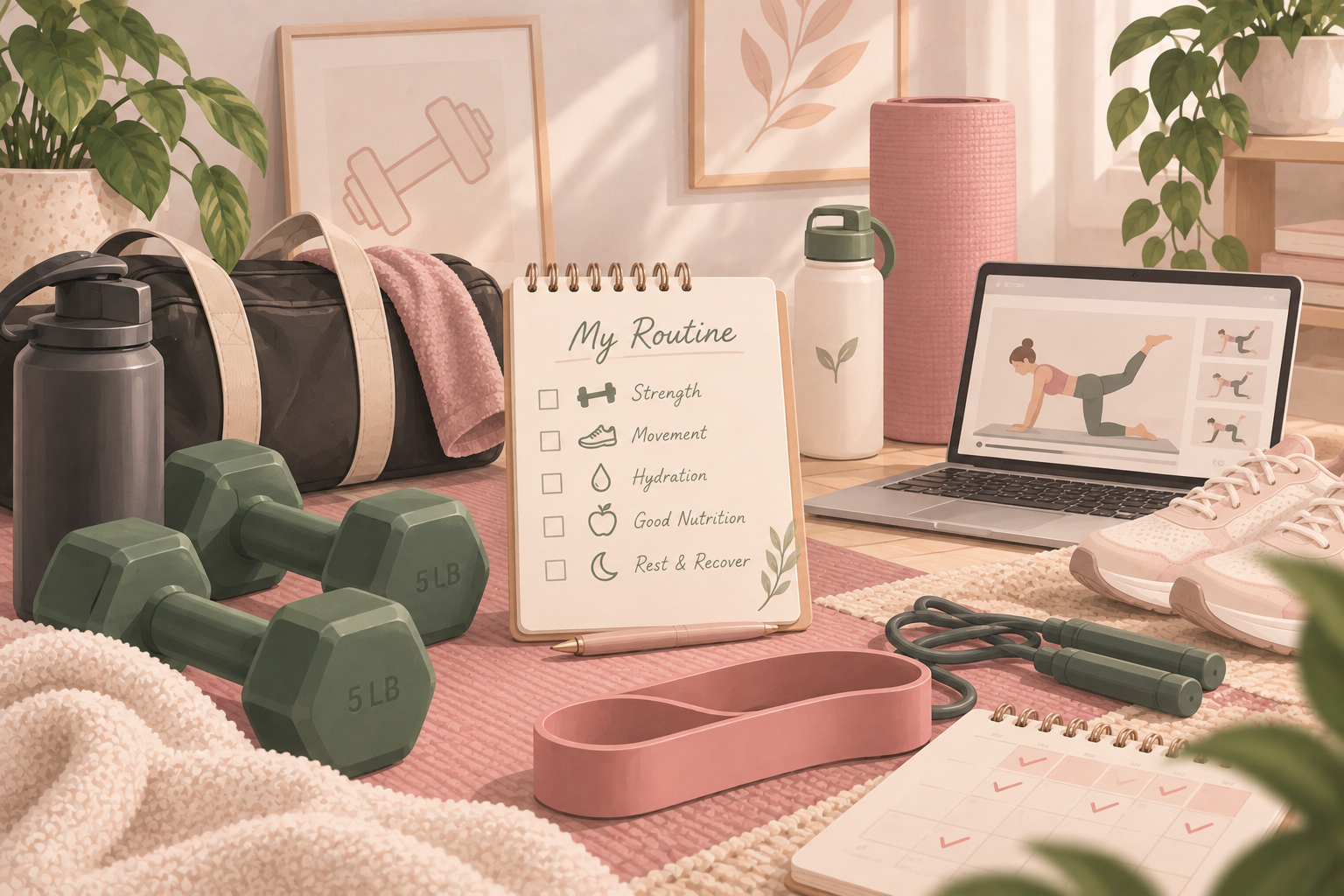
So one day you decide you want to get a little stronger, because healthy lifestyles are trending again. Hey, it should be simple enough, right?
Until you open Instagram, TikTok or YouTube and suddenly someone is explaining their six-day gym split, another person is tracking twelve different exercises in an app, there’s others recommending movie-length workout videos and someone else seems to own enough equipment to open a small commercial gym from their garage.
And now your very normal, average person goal of “hey, I’d like to be a little stronger” has somehow turned into: Do I need a gym membership? A full routine? Machines? Dumbbells? Leg day? Chest day? Whatever push past failure is?
Or can getting stronger actually be… simpler and user-friendlier than all of that?
The Short Answer
Yes, way simpler.
You do not need a full gym routine or tonnes of fancy equipment to get stronger.
What you do need is some form of resistance that challenges your muscles enough to adapt to this exercise- and ideally, that challenge also needs to increase as you become stronger.
Large-scale resistance-training evidence among the included evidence shows that training improves strength across many possible different approaches, while things such as equipment type and exercise complexity don’t consistently determine whether your future training routine actually works.
So in plain English: Your muscles can’t actually tell whether or not you’re doing the exercise right next to your comfy recliner setup or you’re sweating in an expensive gym while your coach is yelling 4 more for the third time that day.
Muscles know one thing: they respond to being challenged adequately.
This can be in a gym setting, or not. Gym is definitely not the only way.
What Does The Evidence Actually Say?
The reassuring part here is that resistance training itself has a very strong evidence base of well designed, large-scale studies and their results.
A 2026 American College of Sports Medicine position stand pulled together 137 systematic reviews involving more than 30,000 participants. This gives us a substantial evidence base to work with. Overall, resistance training improved strength, muscle size, power and several measures of physical function.
But here’s the interesting bit for our question: The researchers found that equipment type and exercise complexity did not consistently change training outcomes. In other words, your muscles don’t demand a cable machine, squat rack and seventeen-step workout routine before they activate and are willing to become stronger.
Smaller studies looking specifically at home exercise back this up. Middle-aged adults improved fitness measures following low-load home-based resistance training performed only twice a week, while studies in older adults have shown improvements from relatively simple home programs as well.
One 2024 study even had older adults perform unsupervised bodyweight exercises such as sit-to-stands and knee extensions at home three times per week. After eight weeks, both training groups improved muscle power despite having no traditional gym setup.
So the evidence isn’t really saying: “Hey, Gym = strength!” It’s saying: “Resistance training = strength.” The nuance isn’t in where you challenge your muscles, but how.
🔬 For the curious: What is this based on?
The big ACSM review is doing most of the heavy lifting for the answer here. Rather than relying on one small experiment, the researchers synthesized evidence from 137 previous systematic reviews, covering more than 30,000 healthy adults. Resistance training consistently improved strength compared with doing no resistance exercise.
There were things that influenced how much strength people gained. Heavier loads tended to produce larger improvements in maximal strength, and factors such as training at least twice weekly, using a full range of motion and performing multiple sets could improve results.
But that is very different from saying you need a complicated routine. While you can always work on optimization of your training routine, for it to just work a lot less of that is required.
What Changes The Answer?
There is one rather important catch that determines if you will actually get stronger, or not. That is that the exercise eventually has to challenge you.
Doing ten bodyweight squats may feel more than difficult, like death even when you’re just starting out. Six months later, the exact same ten squats happen almost automatically and you will barely notice the strain.
Now hold on, I know what youre thinking! That doesn’t mean you now need a gym + routine combo. It just means some form of progression becomes important. This can happen in a multitude of different ways such as:
adding resistance, choosing a harder version or type of the exercise, doing more repetitions overall, increasing your range of motion from small to large or otherwise making your muscles work harder as they adapt.
And if your specific goal is to become as strong as possible, heavier resistance does appear to offer an advantage for maximal strength.
So to summarize: Do I need heavy weights to become at all stronger? NO.
Can heavier weights be really useful if I want to maximize strength potential as fast as possible? Absolutely.
But once again, not the same question, not the same goal, not the same result!
What Does This Mean In Real Life?
If the thought of joining a gym, learning twenty new exercises and following an elaborate training program is the thing making you go, “oh gosh, no” and stopping you from starting resistance training…no worries, you can relax, it’s actually not that complex.
A simple home routine using bodyweight, resistance bands, dumbbells or whatever safe resistance you have access to can still challenge your muscles and make you stronger. The important part is that you actually do it consistently and that the exercises don’t remain permanently easy, or results will definitely slow or stall.
That also means your routine doesn’t need to look impressive online or the same as the ones you see online. Something as boring as pushing movements, pulling movements and a few other exercises covering your major muscle groups can be far more useful than the world’s most scientifically optimized program that you absolutely hate and therefore never do.
A gym can make progression and exercise variety easier. Of course, that’s like its whole purpose. But we have to remember, that it is a tool, not an entry requirement for your progress in gaining strength.
🕳️ 🐇 So researchers are studying… exercise snacks?!
Yep. Apparently we have reached the point where exercise now also comes in snack form. Researchers have been investigating something called resistance exercise snacking. Which basically are very short resistance-training sessions that can be fitted into normal daily life rather than performed as one long workout.
One pilot randomized study asked older adults to perform nine-minute home sessions containing movements such as sit-to-stands, squats, calf raises and step-ups either once, twice or three times per day. Participants had very high adherence and generally found the approach practical and enjoyable.
However -important science distinction here- this particular study was primarily testing whether exercise snacking was feasible, not proving that the nine minutes is a magical strength-building formula that will make you go from 0 to 100. The study was small and short, and changes in physical function weren’t clearly better than the control group. Still, I think the concept is pretty cool.
Why? Because it challenges the idea that resistance exercise has to involve the entire gym process of changing clothes, driving to a gym and spending an hour following a perfectly organized routine, sweating as much as possible then dragging yourself home before it counts.
One thing i’d like my readers to remember from this post is specifically: that sometimes doing a little, but making that little purposeful, can be a much more realistic approach than choosing to wait for the perfect routine to appear.
EVIDENCE VERDICT
Getting stronger without a full gym routine? Strong evidence.
How convincing is the evidence?
●●●●
Does it change what we should do?
Probably, especially if complexity is what’s stopping you from starting.
The included evidence gives us very little reason to believe that complicated routines or specific gym equipment are prerequisites for becoming stronger. Taken together, the included evidence comes to a similar conclusion: that what matters is resistance training itself. With special focus on consistently challenging the muscles and adjusting that challenge as your body naturally adapts.
A gym may make all of that easier and give you more options, but you absolutely do not need to pay for an expensive membership, find a perfect program or free up a two-hour block in your day before strength training becomes worthwhile.
The Bottom Line
You do not need the full gym package to get stronger.
Your muscles need consistent resistance that challenges them, with that challenge increasing as you adapt. A gym membership doesn’t determine whether that happens.
So in reality: The best strength routine is not necessarily the fancy 12-machine, 15-step one a gym membership might be offering you. It’s the one you’ll actually keep doing, and that challenges you enough.
References
View the studies behind this article
- Currier, Brad S et al.
American College of Sports Medicine Position Stand. Resistance Training Prescription for Muscle Function, Hypertrophy, and Physical Performance in Healthy Adults: An Overview of Reviews
Medicine and science in sports and exercise vol. 58,4 (2026)
[Read the Study] - Kikuchi, Naoki et al.
Effect of Online Home-Based Resistance Exercise Training on Physical Fitness, Depression, Stress, and Well-Being in Middle-Aged Persons: A Pilot Study International journal of environmental research and public health vol. 20,3 (2023)
[Read the Study] - Alan M. Jette et al.
Home-Based Resistance Training: Predictors of Participation and Adherence
The Gerontologist (1998)
[Read the Study] - Fyfe, Jackson J et al.
Feasibility and acceptability of a remotely delivered, home-based, pragmatic resistance ‘exercise snacking’ intervention in community-dwelling older adults: a pilot randomised controlled trial
BMC geriatrics vol. 22,1 521. 25 Jun. 2022
[Read the Study] - Kuptniratsaikul V etal.
Efficacy and safety of a simple home-based resistance exercise program for older adults with low muscle mass: a prospective longitudinal clinical trial.
Int J Rehabil Res. (2021)
[Read the Study]
Written by A Dose of Proof
Health research can be fascinating — but the way it’s written often makes it much harder to understand than it needs to be.
A Dose of Proof is the voice behind After the Abstract, translating health research into clear, evidence-focused explanations that look beyond the headline — including what a study found, what it didn’t prove, and whether the results actually matter.

Leave a Reply